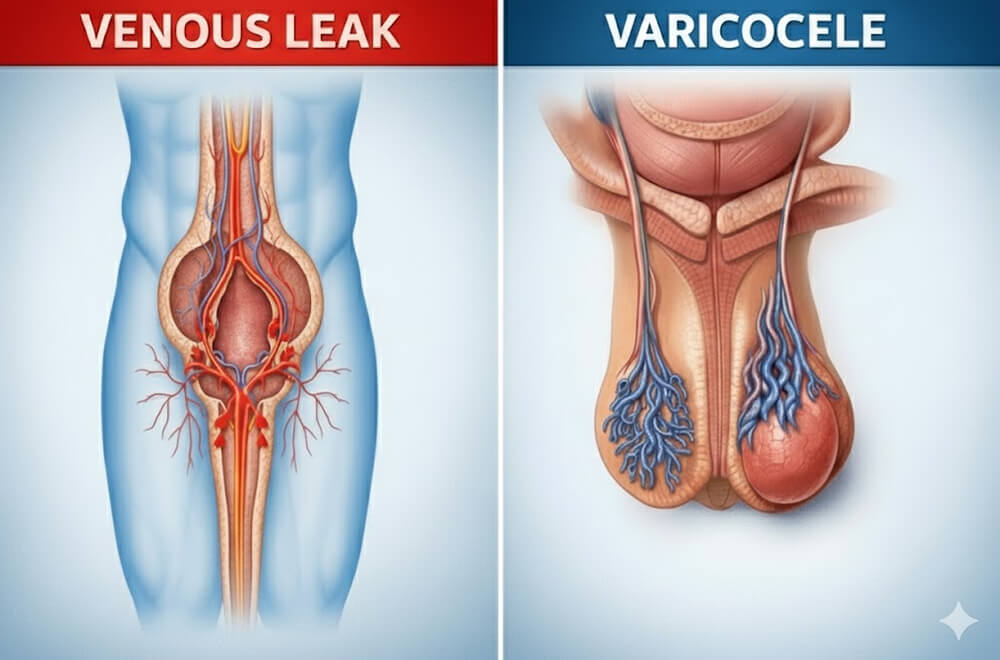
A question patients repeatedly ask is both technical and important: why does treatment choice matter so much when dealing with varicocele, especially when symptoms persist or return? This question sits at the heart of the debate around varicocele embolization vs surgery, and understanding it properly often changes how patients approach care.
The answer starts with a simple clinical reality. Varicocele rarely exists alone. In the overwhelming majority of cases, it appears alongside abnormal venous drainage patterns that continue to affect blood flow if left untreated. Any effective varicocele treatment must account for this from the very beginning.
Why Treating Varicocele Alone Is Often Not Enough
Doctors can treat this condition in isolation because it is visible and straightforward to identify. Dilated veins appear clearly on imaging and physical examination. However, experience shows that varicocele almost always coexists with deeper venous dysfunction.
In more than 95 percent of cases, specialists identify an associated venous leak during detailed imaging. This number remains conservative. Whenever a venous leak appears, a varicocele accompanies it.
Treating only one part of the problem limits success. Closing a single pathway while leaving another open allows abnormal blood flow to continue. Symptoms may temporarily improve, but they rarely stay resolved.
Seeing the Full Problem During Treatment
Modern imaging changes everything. During venography performed for varicocele, doctors often see the venous leak immediately and clearly. At that point, no further tests are needed. Venography acts as the gold standard and allows patients to see the problem themselves.
This visibility matters. It removes guesswork. It ensures that treatment decisions rely on anatomy rather than assumptions.
Embolization offers a distinct advantage here. It allows real-time visualization of all abnormal veins during the same session. Surgery, by contrast, focuses on surface veins and cannot always access deeper venous pathways.
Varicocele Embolization vs Surgery: Understanding the Real Difference
When patients compare varicocele embolization vs surgery, they often focus on recovery time or pain. While those factors matter, the real difference lies in completeness.
Surgery treats this condition through incisions and vein ligation. It addresses what the surgeon can see and reach. The pain-free method treats varicocele internally using a catheter guided through the venous system. This approach allows the specialist to identify and seal all abnormal drainage routes.
As a result, embolization frequently resolves both varicocele and venous leak in one controlled, minimally invasive procedure.
Can Varicocele Be Cured Without Surgery?
The answer is yes, when proper evaluation guides treatment, embolization treats the underlying venous problem without cuts, stitches, or general anesthesia. Patients return home the same day and resume normal activity quickly.
More importantly, embolization addresses the full venous picture. That is why, when patients ask, specialists confidently recommend this procedure as a durable option rather than a temporary fix.
Varicocele Embolization Success Rate and Reliability
Clinical outcomes consistently demonstrate a strong varicocele embolization success rate when performed by an experienced interventional specialist. Patients report lasting pain relief, improved comfort, and restored confidence.
Because this procedure visualizes and treats all contributing veins, recurrence rates remain low. A reliable success rate depends on accurate diagnosis, proper sequencing, and technical precision from the right specialist with expertise in the procedure.
Final Thoughts
The decision between varicocele embolization vs surgery should rest on evidence, anatomy, and experience. When specialists treat the full venous problem in the correct sequence, results last.
Patients seeking clarity, privacy, and confident guidance benefit from physicians who understand venous disease at its deepest level and apply treatment with precision rather than force.
Consultation and Next Steps:
For individuals seeking expert consultation for conditions such as venous leak and varicocele, appointments are available with Dr. Imtiaz, a highly experienced specialist known for advanced, minimally invasive vascular care. Consultations follow internationally accepted medical standards, with a strong emphasis on patient safety, discretion, and long‑term outcomes.
Contact for Consultation
Hotline: 03311110397
wa.me/+923302963300
wa.me/+923312597322
Dr. Imtiaz Ahmad
Frequently Asked Questions
Q: Can embolization and venous leak treatment happen together?
A: Yes. Imaging often reveals both conditions during the same session, allowing complete treatment.
Q: Is embolization safer than surgery?
A: Embolization avoids incisions, reduces complications, and preserves surrounding structures.
Q: How quickly do patients recover after the incision-free procedure?
A: Most patients resume normal activity within 24 to 48 hours.
Q: Does embolization affect fertility?
A: Embolization preserves testicular tissue and supports improved testicular function.

Prof. Dr. Imtiaz Ahmad
Endovascular Surgical Specialist and Interventional Radiologist
Prof. Dr. Imtiaz Ahmad completed his Fellowship at Northwestern University, Chicago in 1995 and has over 25 years of practice across 25+ teaching and community hospitals in New York, New Jersey, and Connecticut. He is triple board-certified by the American Board of Radiology (DABR, DABR-VIR, DABR-IR/DR) and currently serves patients at Farooq Hospital in Lahore and OMI Hospital in Karachi, with online consultations available worldwide.
Still Have Questions?
Speak directly with our team — we’re happy to guide you.
0331 111 0397
24/7 Hotline · Lahore & Karachi