Image Guided · Minimally Invasive
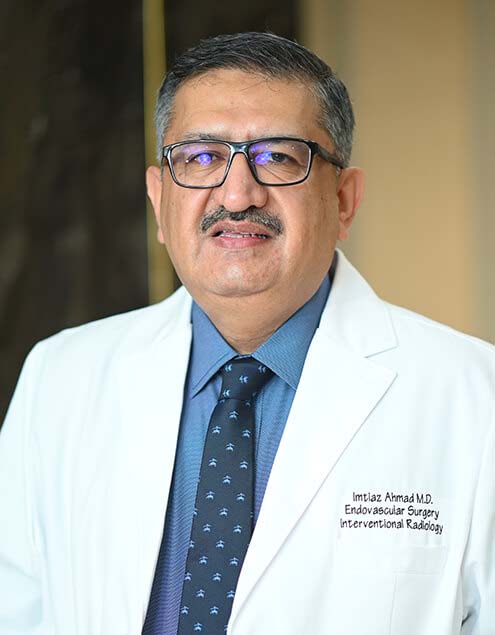
Vascular and interventional radiology uses image-guided techniques to diagnose and treat disease through small punctures rather than open surgery. As a vascular specialist in Pakistan, Prof. Dr. Imtiaz Ahmad performs catheter based treatment in Pakistan across a wide range of vascular and non-vascular conditions, bringing this subspecialty to Lahore and Karachi.
20
+
Years in Practice
500
+
Procedures Done
2
Cities Served (Lahore & Karachi)
DABR
Board Certified Specialist
No Surgery RequiredWalk-in, Walk-out Procedure
What Is Interventional Radiology?
A Specialty Built on Image Guided Treatment
Radiology covers the diagnosis and treatment of disease using imaging, and interventional radiology is the subspecialty that takes this a step further. An interventional radiologist uses live imaging, ultrasound, fluoroscopy, X-ray, or CT scanning, to guide catheters, needles, and other small instruments directly to the affected area. Instead of the large incisions required for open surgery, vascular and interventional radiology relies on small punctures, offering patients a minimally invasive route to treatment with greater precision, less pain, and faster recovery.
Precision Through Imaging
Real time imaging allows the exact vessel, organ, or tissue to be targeted, improving accuracy over conventional surgical approaches.
Minimally Invasive by Design
Procedures are performed through small punctures rather than open incisions, reducing pain and the risk of complications.
A Wide Range of Applications
From vascular disease to women’s and men’s health, interventional radiology offers a non-surgical option across many conditions.
Conditions Treated
What Interventional Radiology Can Treat
As a vascular specialist in Pakistan, Dr. Imtiaz Ahmad applies image guided treatment across a broad range of disease categories, using embolization procedures in Pakistan that were previously only available.
Vascular and vessel disease
Uterine fibroids, adenomyosis, and pelvic congestion syndrome
Varicocele and venous leak in men
Cancer and tumor management
Kidney and urology related disease
Liver disease management
Venous access and dialysis support
Important: The right interventional radiology procedure depends on the specific condition being treated.
How an Interventional Radiology Case Is Approached

Clinical Consultation
A detailed review of symptoms, history, and prior treatments tried.
A detailed review of symptoms, history, and prior treatments tried.

Diagnostic Imaging
Ultrasound, CT, or other imaging to confirm the diagnosis.

Vascular or Organ Mapping
Detailed imaging of the relevant vessels or structures to plan the procedure.

Suitability Assessment
Confirming candidacy for a minimally invasive approach.

Procedure Planning
Finalising the access point and treatment strategy before the day of the procedure.
The Approach
How Minimally Invasive Procedures Work
Procedures are performed in a dedicated vascular and interventional radiology suite, using live imaging from start to finish.
Local Anaesthesia & Access
A small puncture is made at the access site, typically in a vein or artery. General anaesthesia is rarely needed.
1
0
Image Guided Navigation
A catheter or needle is guided to the treatment site using ultrasound, fluoroscopy, or CT imaging.
2
0
Targeted Treatment
The specific procedure, whether embolization, biopsy, or another intervention, is carried out under direct image guidance.
3
0
Same-Day Recovery
Most patients are monitored briefly and discharged the same day, with follow-up calls to track recovery.
4
Comparison Table — “Interventional Radiology vs Open Surgery”
FEATURE
Type of Procedure
Anaesthesia
Incision
Hospital Stay
Recovery Time
Pain Level
Image Guidance
Interventional Radiology (Dr. Imtiaz)
Open Surgery
Why Choose Us
Pakistan’s Pioneer in Interventional Radiology
Vascular and interventional radiology demands precision, imaging expertise, and broad clinical experience. Prof. Dr. Imtiaz Ahmad brought this subspecialty to Lahore and Karachi and continues to lead its practice in Pakistan.
Northwestern Fellowship
Fellowship trained at Northwestern University, Chicago, in 1995, with over two decades in interventional and endovascular practice.
Pioneer in Pakistan
Among the first to bring vascular and interventional radiology procedures to Lahore and Karachi.
Broad Clinical Range
Experience across vascular, women’s health, men’s health and oncology related interventional procedures.
Trusted Across Pakistan
Patients travel from across the country, and internationally, for image guided treatment.
Patient Stories
What Patients Say
Men who were hesitant about surgery have found a more comfortable path to relief through PAE.
”We are very happy with this treatment. We have been followers of Dr. Imtiaz Sahib for years. Dr. Usama Sahib first saw us, and we are thankful to both Dr. Imtiaz and Dr. Usama for their guidance and support.
Abdul Rauf, 64Lahore, Pakistan
”We are very satisfied with Dr. Imtiaz, his hospital staff, and their services. The environment is clean, hygienic, and professional. I highly recommend everyone to visit Dr. Imtiaz for treatment. I am extremely thankful for their excellent care and trained staff.
Saleem Khan, 58Dubai, UAE
”I am very satisfied with Dr. Imtiaz and his staff. Their care, professionalism, and supportive behavior made the experience excellent. I am truly thankful to Dr. Imtiaz and the entire team for their kindness and outstanding service.
Muhammad Farooq, 61Karachi, Pakistan
Desclaimer: The testimonials featured on this page reflect the genuine experiences of patients personally treated by Prof. Dr. Imtiaz Ahmad. Each story is shared with the patient’s informed consent and has not been edited to misrepresent their outcome.
FAQ
Common Questions About Interventional Radiology
Have more questions about vascular and interventional radiology? Get in touch for a free consultation before deciding on treatment.
Speak directly with Dr. Imtiaz’s team
0331 111 0397
Available Mon–Sat, 9am–6pm
What are the minimally invasive surgery alternatives?
Vascular and interventional radiology offers a range of minimally invasive alternatives to traditional surgery, including embolization procedures, catheter based treatment, and image guided biopsies. These approaches use small punctures rather than open incisions, reducing pain, scarring, and recovery time while achieving comparable results for many conditions.
What does an interventional radiologist do?
An interventional radiologist uses imaging techniques such as X-ray, ultrasound, fluoroscopy, or CT scans to guide catheters, needles, and other small instruments to a precise location in the body. Rather than performing open surgery, they diagnose and treat disease through small punctures, offering a less invasive route to definitive treatment.
What conditions can interventional radiology treat?
Interventional radiology treats a wide range of conditions, including vascular disease, uterine fibroids and adenomyosis, varicocele and venous leak, prostate artery embolization for enlarged prostate, kidney and liver disease, and certain cancers and tumors. The image guided approach allows precise treatment across multiple organ systems.
What are the benefits of minimally invasive vascular treatments?
Minimally invasive vascular treatments offer smaller incisions, less pain, lower risk of bleeding and infection, and significantly shorter recovery times compared to open surgery. Most procedures are performed under local anaesthesia or mild sedation, allowing patients to return home the same day and resume normal activity sooner.
Related Treatments
Other Minimally Invasive Treatments
Free First Consultation
Considering Treatment Without Surgery?
Book a free consultation with Prof. Dr. Imtiaz Ahmad, a US board-certified specialist in Pakistan, available in Lahore, Karachi, and online from anywhere in the world. We are happy to help you understand your options clearly and without pressure.
Lahore
Farooq Hospital, DHA, 0331 111 0397
Worldwide
info@drimtiazahmad.com
Karachi
OMI Hospital, MA Jinnah Rd, 0331 111 0397